TEACHER'S GUIDE FOR BEFORE MY EYES...
"Before My Eyes, by Caroline Bock, takes the reader through the last few days of summer from the perspectives of three narrators: two teens and a mentally-ill young adult. Bock skillfully weaves together the topics of schizophrenia, gun violence, family issues, and typical adolescent angst while at the same time providing a compelling story. Though the reader gets a glimpse of the book’s climax in the first few pages, the end plays out in an unexpected way when unlikely heroes emerge. As a retired Professor of Education, I believe Before My Eyes would be an excellent book for an 11th or 12th-grade English class, and since it provides a realistic portrayal of schizophrenia, it might even be a good choice for an AP Psychology class. Whatever one’s reason for choosing this book, the reader will not be disappointed."—Edmund Sass, Ed.D., Professor Emeritus of Education
SYNOPSIS:
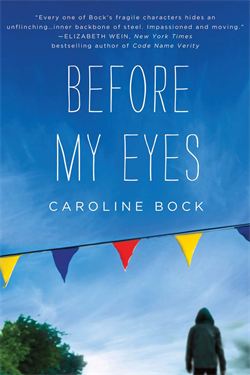 Before My Eyes
 is a powerful young adult novel about a fateful summer’s end in the fictional Long
Island town of Lakeshore, New York. Following on the path of her acclaimed
debut young adult novel,
LIE, Bock brings forth complex
characters in nuanced, descriptive
language, layering relevant contemporary themes: Gun violence, mental illness,
prescription drug abuse, and internet risks with timeless themes of love and hope.
Before My Eyes captures a moment when possibilities should be opening up,
but instead everything teeters on the brink of destruction.
Before My Eyes
unfolds in the tightly woven first person narratives of Claire,
Max and Barkley. Claire has spent the last few months taking care of her
six-year-old sister, Izzy, as their mother lies in a hospital bed.
Claire believes she has everything under control until she meets a young
man online who
appears to be a kindred spirit. She is initially flattered by the
attention but when she meets Max, the shy state senator’s son, her
feelings become
complicated. Working alongside Max at a beachfront food stand is
Barkley.
Lonely and obsessive, Barkley has been hearing a dangerous voice in his
head. No
one—not his
parents, not his co-workers—realize that
Barkley is suffering from paranoid schizophrenia, until the voice in his
head
orders him to do the unthinkable.
What
is seen/unseen, concealed/unconcealed, and ultimately known/unknown layers this
richly metaphorical text, and along with the deeply felt characters, makes Before
My Eyes
a novel that teens and their adults will be eager to read, discuss, and
analyze
SETTING:
The setting is critical to understanding how the author of Before
My Eyes structured the text in order to build suspense and develop
multi-dimensional characters. Here follows insight into the setting:
Place: The town of Lakeshore in Long Island, New York, about
thirty miles east of New York City during the end of a simmering hot summer.
The majority of the novel takes place at the fictional Lakeshore town and at
its town beach along the Atlantic Ocean on the southern shore of Long Island.
In New York, state parks, most notably, Jones Beach, are open to all for a
modest fee. However, as is commonplace, there are more exclusive ‘town’ beaches
where one must be a resident in order to use a beach, and that is the case with
this setting. This exclusive town beach gives the teens the illusion of safety
and security.
Time: The novel opens on Labor Day Monday at a community
park in Lakeshore at an event for state senator Glenn Cooper, who is running
for re-election and is the father of Max Cooper. Barkley, suffering from what
we will soon understand to be paranoid schizophrenia, is outside the tent—a gun
concealed in his sweatshirt. Max is insider the tent. The foreshadowing is
there in the text—there is going to be tragic confrontation—but who are these
two young men? And who is the girl, Claire, that they are both waiting to see
will also appear? After these two short chapters, the novel will flashback to
the Thursday prior and follow our three main characters—Barkley, Max and
Claire—back to this fateful day, and one day beyond for a total of six critical
days in the lives of these three teens. Day and times are marked at the head of
each chapter in order to give the reader a sense that every moment of life is
critical.
CHARACTER and
METAPHOR:
Three first-person points of view comprise this novel:
Barkley, Max and Claire. One of the central metaphors of Before My Eyes is the
idea of what is before ones eyes is often not seen at all and not understood.
These characters are each hiding things—often from their parents, their
friends, and themselves. To extend the metaphor of what is seen or not seen in
the novel, a student should analyze these complex characters by looking closely
at textual details. Here is a short description of each character:
BARKLEY
-- is a twenty-one year old, drop out from
community college, a would-be filmmaker and environmentalist and
grammar fanatic.
He is also suffering from undiagnosed paranoid schizophrenia. He
is obsessed
with Claire. His parents do not “see”
what is happening to him, though they know something is wrong and
are in conflict with him over his behavior and what to do to help. Special note:
most of the
scenes between Barkley and his parents,happen
with Barkley behind his closed bedroom door, and his parents pacing
on the other
side. No one “sees” that right before his or her eyes, Barkley is
losing touch
with reality, texting the Max's father, a state senator running for
re-election, and hearing a voice in his head. He spends hours in his
room on video games, on the internet, drinking coffee, not sleeping, not
bathing.
MAX --is about to turn eighteen
years old as the novel opens. He is the son of New York state
senator Glenn Cooper
and his campaign manager and wife, Debbi Cooper. He has
spent his summer working at the Snack Shack at the town beach and
obsessing
about a missed penalty kick in the last soccer game of the year and
the seemingly
unattainable girls in bikinis on the beach. He is also using his
father’s prescription pain medicine to dull his
imagined physical and psychological pain. Notably,
Max has a dog, King, a blind dog, and it’s this brave dog who plays
a pivotal role in the action of the novel. To sum up, on the
surface,
Max has everything going for him—loving parents, nice car, senior
year, but he
hides and conceals his prescription pain
medicine drug abuse—and his despair.
CLAIRE— seventeen-year
old Claire has been taking care of her six-year old
sister, Izzy, short for Elizabeth ever since her mother suffered
an aneurysm earlier in the spring. With her father barely
able to cope—emotionally or financially—with
his wife’s
rehabilitation he does not notice or “see” the sadness overcoming
his dreamy, literary elder daughter Claire. She
turns to the Internet to blog her poetry. Online she meets “Brent,”
who is in truth “Barkley,” but she doesn’t “see” this until
it is almost too late. Claire conceals her unhappiness from everyone—even
in a key scene, diving into the ocean and being caught
by an unseen riptide, and almost drowns, a foreshadow of
her own hidden fate. Ultimately, it is Claire who uncovers or sees
clearly what she must do—to face life or death, and to find love.
INSIGHT INTO THE
WRITER’S RESEARCH:
A wide cross section of research and outside sources were
consulted in order to develop realistic, complex characters and themes.
The novel was
inspired in part by a true event: I was taken aback by what happened in Tucson,
Arizona on January 8, 2011, the
day U.S. representative Gabrielle Giffords and eighteen others were shot during
a meeting at local supermarket
Six people died, and many others were injured by Jared Loughner, a
22-year old Tucson man. I followed this case closely in news reports, shocked
and angry, before I began to write this novel.
In addition, key outside sources and research was utilized
to write this novel.
On a personal level, the novel was reviewed by Dr. Frances
Bock, PhD, a neuropsychologist, and by David Blech, a nurse practitioner with
experience working with psychiatric, particularly young male schizophrenics.
Both are close relatives of the author and offered a careful reading of early
drafts of the novel in order to help shape Barkley’s story. In addition, many
books and websites regarding mental illness in teens, most notably the
National
Alliance on Mental Illness (NAMI), were consulted.
Research on gun violence and gun control in the United
States, a controversial subject under much debate in our society, was also
critical. The websites of the Brady Campaign to Prevent Gun Violence, Mayors
Against Illegal Guns and Moms Demand Action for Sensible Gun Control were also
researched for key points on gun violence and young people. And while a novel
is by its very nature not a work of journalistic balance, but a subjective
story of people and their actions, I also considered the other side of
the debate, those that advocate for gun owners, The National Rifle Association.
Ultimately, the background research done on this novel
should only serves to enrich the character’s lives and situations, and I hope
this research lends to the richness and complexity of Before My Eyes.
SUGGESTED QUESTIONS
FOR CLASS DISCUSSIONS AND ACTIVITIES
1.
Analyze how these complex characters—Barkley,
Max, and Claire— each with multiple or conflicting motivations, develop over
the course of the novel? How do they interact with one another? How do they
each contribute or develop the overall theme of the novel?
2. In particular, is there a point in the novel in
which one can express empathy for Barkley (i.e. it is both implied and inferred
that he has been bulled throughout high school and that he has been exhibiting
signs of mental illness for several years)? But how does the author pivot the
reader’s empathy away from Barkley toward Max and/or Claire?
3.
What inferences can be drawn by the opening two
chapters of the novel? How does setting the novel up in the present time, and
then flashing back, to the past add suspense to the novel? How does the
reader infer the mental states of Barkley and Max at the beginning of the time,
citing specific textual references.
4. How does the title, Before My Eyes, describe a central metaphor or idea in the text?
How does it emerge and shapes the text through the characters and what they see
or hide, what they conceal or reveal, to their parents and peers? Suggested activity: Have the
students closely analyzed each of the main characters and create a chart or
character map that cites specific textual references on what is seen/not seen
or unconcealed/hidden or unknown/known by parents and peers.
5. Claire writes poetry—several poems are included
in her sections in the novel. She results as a result of the loneliness, and
ultimately, out of the anger she feels. Look at the poems closely? What are the
central ideas in the poems and how do they relate to the larger themes of the
novel? Suggested activity:
have students write their poems inspired by the novel and/or building on the
metaphor of what is seen/unseen about them or their world. (Special note
to teachers from the author: I was the editor of my high school literary
magazine, Opus, at New Rochelle High School in New Rochelle, New York and
referred to back issues to remember how it was to write as a seventeen year
old, and to write Claire’s poetry.)
6.
The novel infers a particular point
of view on gun violence and the mentally ill, without being pedantic or a “message” novel. Read the
text closely (particularly the end chapters) and discuss what is that point of
view expressed? What role does Claire’s mother, a psychologist, serve at the
end of the novel? Compare and contrast the different reactions of Claire and
Max to the gun violence. Suggested
activity: In an essay that researches and cites outside sources as well as
specific textual references from the novel, the student’s write their own
response to the issue of gun violence in America.
7. The novel ends on a Tuesday afternoon, with the reference
that the next day, Wednesday, school starts. Suggested activity: In a
creative essay, which builds on textual references and analysis of each
character, have the students describe what happens on that Wednesday either
writing in the character’s point of view or writing an analytical essay about
what should or could happen.
----
Special note on the first print edition of Before My Eyes: Erratum,
an error in printing or writing. The error is in the writing and the author
takes full responsibility. A quote attributed on p. 169 to Lewis Carroll, “All
that we see or seem is but a dream within a dream,” is in fact attributable to
Edgar Allan Poe from his poem, ”A Dream Within A Dream.” I trust the publisher will correct this in subsequent print editions.
---
LIE for Grades 8-12
 LIE is a novel for the today’s student reader – bringing
with it a complex world view, of teenagers – and adults—making key,
life-changing decisions to tell the truth or lie about a hate crime. I
have attempted to outline key questions, which are culled from the Common Core standards for
English language instruction in New York for grades 8-12. In some cases, I have added author's notes, which are hopefully insightful
and directional, but certainly not the
final word on the text I am sure
that there are close readers out there who will interpret the text in a more
rigorous way than even the author.
LIE is a novel for the today’s student reader – bringing
with it a complex world view, of teenagers – and adults—making key,
life-changing decisions to tell the truth or lie about a hate crime. I
have attempted to outline key questions, which are culled from the Common Core standards for
English language instruction in New York for grades 8-12. In some cases, I have added author's notes, which are hopefully insightful
and directional, but certainly not the
final word on the text I am sure
that there are close readers out there who will interpret the text in a more
rigorous way than even the author.
Summary: As the novel opens, seventeen year-old Skylar Thompson is being questioned by the police. Her boyfriend Jimmy stands accused of brutally assaulting two Latino brothers from a neighboring town, and she's the prime witness. Skylar is keeping quiet about what she's seen, but how long can she keep quiet? Since her mother died before the start of her senior year in high school, Jimmy has been everything to her. She never had a boyfriend before Jimmy. And everyone in the school wanted to be his friend. He was the star of the football and baseball teams. He was a Scholar-Athlete. It was Jimmy's idea to go "beaner-hopping" and beat up random Latinos from the neighboring town. Everybody in school wanted to be part of it. Now, as her best friend Lisa Marie instructs, "everybody knows, nobody's talking."
But Skylar is realizing the enormity of what has happened -- and what she has been involved with over this past school year. She struggles with whether to protect him or to do as her best friend Lisa Marie says -- to say nothing. Jimmy's accomplice on that fateful night, Sean, is facing his own moral dilemma. He must also decide whether or not to turn on his friend in order to save himself. Eight other characters, four teens and four adults, weigh in on why this hate crime happened in this Long Island town and what should happen next. Most importantly, both Sean and Skylar, as the central characters, must figure out why they followed someone like Jimmy in the first place.
This novel is inspired by real events, notably the murder of Marcelo Lucero of Patchogue, New York in November, 2008, a murder perpetrated by young people who were out "beaner-hopping." One of the central themes of LIE is a multi-layered exploration of why people follow those who are acting without regard to consequences, without regard to the law, without regard to other human beings. Another central theme is the internal psychological struggle of the characters, primarily Skylar and Sean, to understand their own motivations, to come to terms with their personal moral dilemma about their participation in this crime. Ultimately, LIE is realistic contemporary fiction, setting out the story of a two young people facing the choice of whether to tell the truth -- or lie.
Setting and Geography Lesson for LIE: Time: Present Day. Location: An unnamed suburban town on Long Island in New York. Long Island is east of New York City and has one main expressway that runs west to east-- the Long Island Expressway, locally called the L.I.E. Yes, the title can be interpreted as a play on words. Please note in several instances that the teen characters want to escape their suburban town. However, when they do drive off -- they drive east. Here's the geography lesson: Long Island is an island -- and if one drives east one can never leave the island -- one only hits the Atlantic Ocean. Conversely, several characters struggle with the idea of driving west, which is towards New York City. Metaphorically, the characters do not give themselves permission to leave and expand their view on the world. Questions for students: Explore how geography affects the character's decisions in LIE? How does the setting/sense of place impact the plot or outcome of the novel? Could this novel be set anywhere in the United States and why?
Key Questions:
Determine a theme or central idea of
the text and analyze its development over the course of the text,
including its relationship to the characters, setting and plot
Analyze how particular lines of dialogue or incidents propel the action, reveal aspects of character, or provoke a decision?
Analyze how difference in points of view and the audience or
reader (e.g. created through the use of dramatic irony) creates suspense?
Author's note: Ten distinct points of view comprise LIE --all of which contribute information about the community and the inciting incident -- the assault masterminded by Jimmy on two brothers, Arturo, the undocumented older brother born in El Salvador, and Carlos, younger and American-born. However, one point of view is missing -- Jimmy's. One of the central themes of the story is how someone like Jimmy, a popular Scholar-Athlete on one hand, a controlling bully and biased individual on the other, influence those around him? Why do people follow people like Jimmy? Ultimately, what does it take to stand up to him? And how is dramatic irony and suspense developed by knowing Jimmy only through the eyes of others, particularly his girlfriend Skylar and his best friend Sean? How do Skylar and Sean's responses vastly differ?
More complex questions for grades 9 and above:
Analyze how complex characters (e.g. those with multiple or
conflicting motivations) develop over the course of the text, interact with
other characters, and advance the plot or develop the theme?
Analyze how an author’s choices concerning how to structure
a text, order events within it (e.g. parallel plots) and manipulate time (e.g.
pacing, flashbacks) create such effects as tension or surprise?
What other texts or eras does LIE connect to?
Author's
Note: LIE is set on Long Island, home to original post
World War II suburban communities. An exploration on the growth of
suburbia and its historical
Other
texts that may be used to contrast and compare with LIE could include
Sherman Alexis' The Absolutely True Diary of a Part-time Indian, which explores about the divisions between American
Indians and whites in his northwestern community. In addition, novels
such as Ralph Ellison's The Invisible Man, which reflect the horrific lynching
experience of African Americans in the early-mid 20th century can
certainly serve to contrast with LIE and its exploration of a modern-day
hate crime. In particular, the prologue and/or chapter 1 "Battle Royale" scene could focus students on the impact of bias and prejudice on an individual and a community.
Author Workshops/Talks to Libraries/Schools/Groups:
I am available for workshops and talks.
"You truly engaged our students through your workshop, and it was fascinating to listen to students add their characters and perspectives to your novel. Many of them reported that they felt they were looking not only at the situation your book portrayed from a different point of view, but they were also looking at writing from a new perspective. I am delighted that your workshop and your interaction with the students went so well." - Stephen Collier, Wheatley High School, Curriculum Associate for English and Language Arts (K-12), in East Williston, New York after a two-hour Caroline Bock creative writing workshop for ninth and tenth graders on "Character Building" in January of 2012.
Additional Thoughts For Educators:
Questions?